
I Thought I had Dealt with My Shame
I thought I had dealt with my shame.
I've spent years in therapy. I've learned a lot about myself, my anxiety, my coping mechanisms, and how the experiences we have growing up don't simply disappear once we become adults. I know healing isn't a one-and-done process. I know old wounds can resurface from time to time.
What I didn't realize was how good shame had become at hiding.
Recently, my therapist gave me homework that sounded surprisingly simple: in safe situations, admit when I don't know something. Ask questions. Allow myself to learn instead of pretending I already have the answer.
The assignment seems straightforward enough. After all, no one knows everything.
But almost immediately, I noticed how uncomfortable it made me.
At a family reunion with relatives, I only see once a year, I found myself catching those moments when someone mentioned something I wasn't familiar with. Instead of my usual instinct to nod along or pretend I already knew, I practiced saying, "I don't know much about that. Can you tell me more?" “Oh, that’s how you cook sunny side up eggs? I do it this way, your way is easier.” It sounds like such a small thing, but for me, it felt surprisingly vulnerable.
That's when I started to realize that shame was still showing up in my life.
The interesting thing is that shame rarely announces itself. It doesn't walk into the room and say, "Hi, I'm shame." Instead, it disguises itself as something else.
For me, it often looks like perfectionism. It looks like feeling like I should already know the answer. It looks like wanting to get everything right the first time. It looks like worrying about how I'm being perceived. It looks like feeling uncomfortable when I make mistakes or when there are gaps in what I know.
And because it hides so well, I don't always recognize it right away.
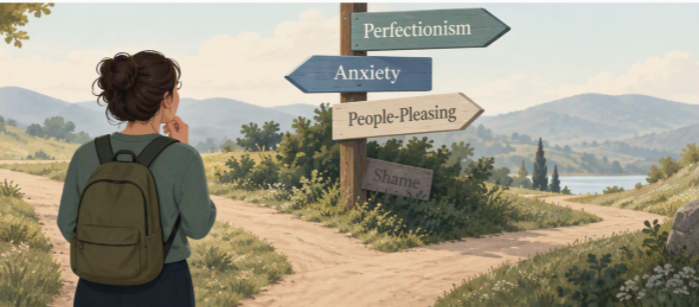
I don't think I believed shame was completely gone. What I didn't realize was that it had gotten so good at hiding that I stopped recognizing it. Instead of feeling ashamed, I felt anxious. Instead of noticing shame, I noticed myself overthinking decisions or pretending I knew something I didn't. It wasn't until I started paying closer attention that I realized shame had been quietly driving a lot of those reactions all along.
That realization explained a lot.
I've struggled with decision-making for as long as I can remember. Not because I can't make decisions, but because what if I make the wrong one? What if things don't work out? What if someone is disappointed? What if I'm blamed?
Looking back, there were many situations where it felt easier to go along with what someone else wanted. If they made the decision, then I couldn't be responsible if it didn't work out. I can see now that wasn't really about being agreeable. It was about avoiding the possibility of getting it wrong.
It was about avoiding shame.
The more I've explored this in therapy, the more I've realized how connected my shame and anxiety really are. In many ways, anxiety feels like it's trying to protect me from shame. If I think through every possible outcome, prepare for every scenario, and make sure everything is perfect, maybe I can avoid feeling embarrassed, judged, or inadequate.
The problem is that anxiety never actually delivers on that promise. It just keeps me stuck.
Thankfully, I've made a lot of progress over the years. One of the biggest changes has been learning to speak up. There was a time when I rarely shared my opinions because I was too worried about being wrong or disagreeing with someone. Today, I'm much more comfortable offering my perspective, even when I'm not completely sure how it will be received.
I've learned something important: my opinion matters.
Not because it's always right. Not because everyone will agree with it. But because I matter, and my thoughts deserve space too.
A lot of this has become even clearer since becoming a parent. My children are 10 years old now, and raising them has taught me as much about myself as it has about them. Watching them learn, make mistakes, ask questions, and figure things out has shown me how important it is for people to feel safe not knowing.
I parent differently than I was parented, and that experience has opened my eyes to how powerful it is when children know they don't have to be perfect. They can make mistakes. They can ask questions. They can change their minds. They can be wrong and still be loved.
I know my parents did the best they could with what they knew at the time. At the same time, I can recognize that some of the messages I absorbed growing up still affect me today. I learned to believe that mistakes had consequences I needed to prevent, and that if I didn't manage every possible outcome, I was somehow responsible for the chaos that followed. Looking back, it's easy to see how that belief fed both my anxiety and my shame.
What I'm learning now is that growth isn't about eliminating shame forever.
It's about recognizing it when it shows up.
It's about noticing when anxiety is actually shame wearing a disguise. It's about catching those moments when perfectionism takes over. It's about being willing to say, "I don't know," and trusting that not having all the answers doesn't make me less capable, less intelligent, or less worthy.
Honestly, admitting I don't know something still feels uncomfortable sometimes.
But every time I ask a question instead of pretending I already know the answer, I'm proving something to myself. Every time I share an opinion instead of staying quiet, I'm challenging an old belief. Every time I make a decision and accept that it might not be perfect, I'm choosing growth over fear.
Shame may still show up from time to time.
The difference is that now I'm getting better at recognizing it before it gets bigger than the situation that triggered it.
And that, for me, feels like progress. 💚
